How to Stop Being the Only One Who Decides What's for Dinner
Every family has one person who carries the dinner question. Not the cooking, necessarily — just the relentless mental weight of deciding. What sounds good. What everyone will actually eat. What's in the fridge. What got vetoed last Tuesday. If that person is you, you already know how exhausting it is. This guide isn't about finding better recipes. It's about building a system so the decision doesn't fall on you alone every single night.
The Real Problem Isn't the Food
Picture this: it's 5:15 on a Wednesday. You've been thinking about dinner since 3 p.m. You planned chicken thighs. Your 8-year-old announces she wants pasta. Your partner says "I don't care" — which, as you've learned, means they care quite a lot and will make a face at whatever you serve. You end up ordering pizza. Again.
The next morning you feel vaguely defeated, not because pizza is bad, but because you did all the mental work and still got overruled.
That's the actual problem. It's not that your family is difficult (well, maybe a little). It's that the decision-making process is broken. One person carries the full cognitive load — the planning, the preference-tracking, the veto-absorbing — while everyone else shows up at the table with opinions and no accountability. The result is either a short-order cook situation where you're making three different dinners, or a nightly negotiation that ends in takeout.
This isn't a recipe problem. It's a negotiation problem.
Why the Usual Fixes Don't Stick
The first thing most people try is asking the family for input. "What do you want this week?" Silence. Or chaos. Your 11-year-old says tacos every single time. Your partner shrugs. Your youngest wants "the noodles" but can't describe which noodles. You collect this information, try to synthesize it into an actual dinner plan, and somehow still end up as the sole decision-maker — just with more steps.
The second attempt is usually a rotating "family choice night," where each person picks dinner once a week. This sounds fair. In practice, the person who picks still has to explain what they want in enough detail for someone to actually cook it, and the other nights revert to the default: you, alone, figuring it out.
What both approaches miss is that the problem isn't who gets to choose. It's that choosing from a blank slate is hard — and most family members aren't willing to do that work. They're much better at reacting than initiating.
The system that actually works flips the dynamic: you give the family a curated set of options and let them vote. You don't ask "what do you want?" You ask "which of these do you want?"
The Buy-In-First Approach to Family Friendly Meals
Here's the shift. Instead of deciding on the week's dinners and then presenting them as a fait accompli, you generate a pool of options — more than you need — and send them to your family before the week starts. Everyone votes on what sounds good. The top picks become the plan.
This works for a few reasons. First, it's much easier to approve or reject something than to generate it from nothing. Your partner can swipe through options in 90 seconds on a Sunday afternoon. Your 8-year-old can actually engage with pictures of food in a way she can't engage with "what do you want for dinner?" Second, when someone votes for a meal, they've implicitly agreed to eat it. The "I don't like this" complaint drops dramatically when the person complaining was the one who approved it three days ago. Third, you're still doing the curation work — which is appropriate, because you're the one who knows about the dairy allergy and the fact that your son won't eat anything with visible onions — but you're not carrying the final decision alone.
The practical version of this looks like: on Sunday morning, you pull up a larger-than-needed set of dinner ideas for the week — say, 14 options when you only need 5 dinners. You share them with your family. Everyone picks their favorites. By Sunday afternoon, you have a week of family friendly meals that the household actually agreed to, a shopping list ready to go, and no Wednesday 5:15 crisis.
What a Real Week Looks Like
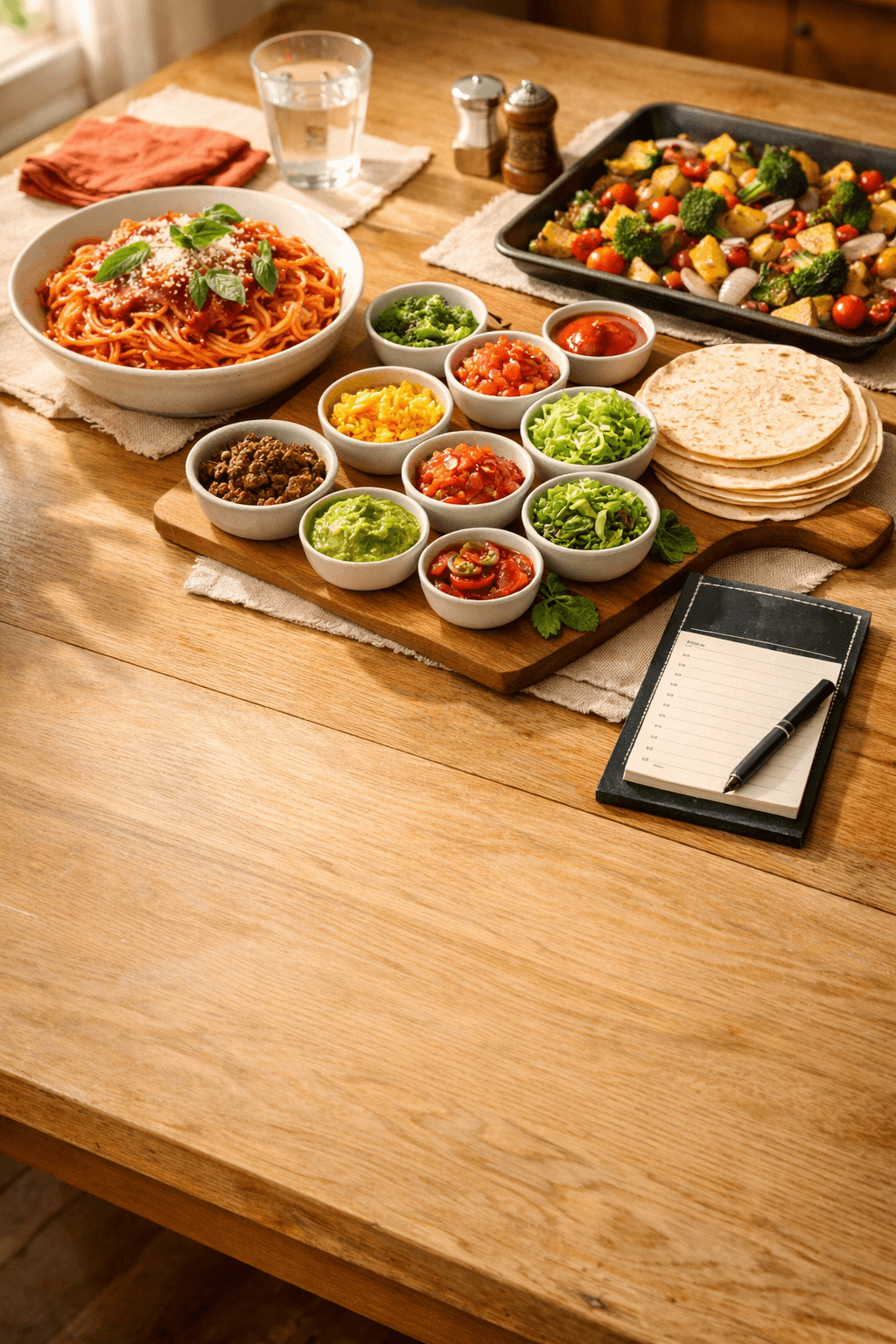
Monday is salmon with roasted broccoli and rice — your pick, voted in by your partner. Tuesday is chicken tacos, which your 11-year-old has wanted every week since October and finally got on the plan. Wednesday is pasta with turkey meatballs, which your 8-year-old voted for and will therefore eat without complaint (this is the miracle). Thursday you're eating out, so it's off the plan entirely. Friday is sheet pan sausage and vegetables — fast, no one vetoed it, done in 28 minutes after a long week.
None of these are elaborate. That's the point. The goal of a picky-eater household isn't culinary adventure — it's getting five dinners on the table that real people will actually eat, without a negotiation every night. What I've found works isn't finding more creative dinner ideas for picky eaters. It's removing the blank-slate decision from the process entirely.
Your mileage will vary based on how old your kids are and how opinionated your partner gets. A family with a 4-year-old and a 14-year-old is going to have different dynamics than one with three kids in elementary school. But the underlying mechanic — curated options, family vote, locked-in plan — holds across most situations.
When the System Gets Complicated
A few edge cases worth addressing, because real families don't fit clean templates.
The "I don't care" partner. Some people genuinely don't want to be involved in meal planning but will absolutely have opinions at the table. For this person, the vote system works because the bar is low — they're not being asked to plan, just to react. Even one or two votes from them means they've got some skin in the game.
The picky eater who only approves three things. If your child's voting pattern is tacos, pasta, tacos, pasta, tacos — you can work with that. Let them have their picks on their nights, and use the other nights for meals the adults actually want. The rotation doesn't have to be democratic in equal shares, just transparent enough that no one feels ignored.
Dietary splits. One vegetarian, one meat-eater, someone avoiding gluten — this is where having a structured plan matters most. When you're building the option pool, you can filter by what actually works for your household's constraints, so the voting happens within a set of meals that are already viable. Nobody votes for something that won't work for them, because those options aren't in the pool to begin with.
The invisible burden of solo dinner planning is real, and it's not solved by recipes alone. The fix is structural: get the family into the decision before the week starts, not after you've already cooked.
Slated: Your whole week of dinners, planned in minutes. Personalized meal plans, family voting, and one-tap Instacart ordering.
Try it free for 14 days
Get Slated for iOSNo credit card required
You might also like
Family Friendly Meals Without the Drama: How to Stop Being the Short-Order Cook
Tired of cooking three dinners a night? This guide shows you a meal planning system that gets your whole family on board before you ever turn on the stove.

Meals for Picky Families: How to Get One Dinner Everyone Actually Eats
Tired of making three dinners a night? Here's a practical system for finding meals for picky families that gets everyone to the table without the argument.

HelloFresh Alternative: What to Do Instead for Weekly Family Dinners
Tired of meal kit boxes that don't fit your family? Here's the plan-based HelloFresh alternative that actually works for real family dinners.